


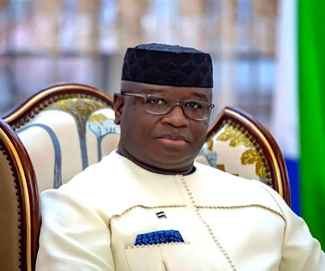
In a defining act of magnanimity, President Julius Maada Bio has granted a full pardon to former President Ernest Bai Koroma, effectively ending all treason-related proceedings and paving the way for his return to Sierra Leone, a decision that underscores his commitment to national healing at a pivotal moment in the country’s diplomatic history.
The Attorney-General’s office confirmed on Tuesday July 14, that the decision was taken in the exercise of the powers conferred on the Attorney-General by the laws of Sierra Leone. Former President Koroma had been charged with offences relating to treason and misprision of treason and was granted bail on medical grounds. As a result of the filing, the proceedings are no longer before the court, and the former President’s bail comes to an end with immediate effect.
Former President Koroma is therefore free to return to Sierra Leone upon the completion of his medical treatment or at any time of his choosing. The decision brings to a close a chapter that had strained political relations and tested the nation’s commitment to reconciliation.
The pardon comes after a period of intense diplomatic engagement. In the immediate aftermath of the November 2023 coup attempt, Koroma had been placed under house arrest and subsequently charged with treason. ECOWAS intervened, brokering a deal that saw Koroma relocated to Nigeria for medical treatment, a move described at the time as a ‘humanitarian gesture’ by President Bio.
President Bio’s decision to pardon Koroma did not happen in isolation. It coincides with a moment of profound regional significance. As Chairman of the ECOWAS Authority of Heads of State and Government, President Bio will be hosting the 69th Ordinary Session of the Authority in Freetown – the largest gathering of regional leaders in Sierra Leone since the OAU Summit of 1980.
The pardon can be read as a direct response to longstanding appeals from ECOWAS leaders who had urged a diplomatic resolution to the Koroma matter. In Freetown, a prominent legal figure had appealed to President Bio to “act with statesmanship and ensure the safe, dignified, and unconditional return of former President Ernest Bai Koroma,” describing such a gesture as essential for national healing and strengthening Sierra Leone’s moral standing as ECOWAS Chair .
The pardon is not an isolated act of magnanimity, rather, it follows a consistent pattern of statesmanship that has defined President Bio’s leadership. In 1996, as a young military officer, he seized power in a coup but voluntarily handed over to a civilian administration within 73 days, prioritising the ballot over the bullet. That act cemented his reputation as a leader whose loyalty was to national stability, not personal power.
More recently, after the November 2023 coup attempt, President Bio faced a crucial test. According to one account, “President Bio named the opposition leader of the All-People’s Congress (APC), former President Ernest Bai Koroma, as the purported mastermind and ordered his arrest and prosecution. Following pleas for clemency from diverse personalities including brother African leaders from the Economic Community of West African States (ECOWAS), President Bio allowed the former President to be granted asylum in Nigeria”.
The same source observed that President Bio “once more demonstrated his huge heart and remarkable statesmanship,” adding that he strongly believes leaders should choose “reconciliation and dialogue” over using force to resolve difficult situations.
Mohamed Bangura, a Member of Parliament, has also commended President Bio’s handling of the situation. “If President Bio were wicked, he would have insisted that Koroma face trial. But he chose otherwise,” Bangura said.
ECOWAS has consistently commended Sierra Leone for its approach. In January 2024, after Koroma was permitted to travel to Nigeria, ECOWAS issued a statement expressing “profound gratitude to the authorities of Sierra Leone for granting permission to Koroma to travel out of Sierra Leone,” describing it as a ‘humanitarian gesture that stands to serve the greater interest of Sierra Leone and the ECOWAS region’.
The regional body renewed its commitment to supporting the government and people of Sierra Leone in their efforts to foster peace and security as well as to deepen democracy and good governance.
The pardon now takes that commitment one step further. By lifting the legal cloud over Koroma, President Bio has not only responded to regional appeals but has also set a powerful precedent for peaceful political dispute resolutions in West Africa.
The timing of the pardon is not accidental. With all West African heads of state poised to gather in Freetown, President Bio has used the summit as a platform to showcase Sierra Leone’s commitment to reconciliation and democratic maturity. His tenure as ECOWAS Chairman has been marked by efforts to restore democracy in neighbouring Guinea and to strengthen democratic norms across coup-prone areas of West Africa.
The decision also reflects President Bio’s belief in institutional strengthening and national cohesion. In his view, the state must be bigger than any individual, and the healing of political wounds is essential for long-term development. The pardon sends a clear message to all and sundry, that Sierra Leone will not be defined by political vendettas, but by its ability to rise above them.
The pardon of former President Ernest Bai Koroma is the latest chapter in President Bio’s long record of doing the heavy lifting for Sierra Leone. From stepping aside in 1996 to implementing transformative education and human rights reforms, and from restoring Sierra Leone’s global prestige to hosting the ECOWAS summit, President Bio has consistently chosen the path of institutional strengthening over personal ambition.
His decision to pardon Koroma, amidst the diplomatic spotlight of the ECOWAS gathering, reflects a leader who understands that true statesmanship is not about winning every battle, but about securing the peace for generations to come.
As Sierra Leone looks toward the future, it does so under a leader who has once again shown that he is willing to carry the weight of history, even when the applause is scarce, and the path is uncertain.
The heavy lifting continues. But the direction is clear – Sierra Leone moves forward.