





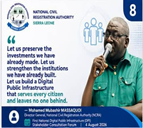
Statement by the Director General, National Civil Registration Authority at the First National Digital Public Infrastructure (DPI) Stakeholder Consultation Forum, 5th August 2026.
Mr. Chairman, Honourable Ministers of Government, Honourable Members of Parliament, the World Bank Country Manager, Distinguished Ladies and Gentlemen, It is an honour to join you today at this historic stakeholder consultation forum on the future of Digital Public Infrastructure in Sierra Leone. Let me begin by commending the organisers of this Forum and His Excellency President Julius Maada Bio for his continued commitment to digital transformation as a catalyst for national development. Today’s consultation is timely. It demonstrates our collective recognition that digital transformation is no longer simply about introducing technology. Rather, it is about building trusted public infrastructure that enables Government to serve its people more efficiently, more securely, and more inclusively. Ladies and Gentlemen, as I reflect on today’s discussion, allow me to do so from two complementary perspectives. Firstly, from a professional, technical, and policy perspective, as someone who has worked extensively in Civil Registration, Legal Identity, and Digital Public Infrastructure—both nationally and through engagement with regional and international initiatives—and who appreciates the transformative potential that DPI offers for national development. Secondly, from an institutional leadership and governance perspective, as the Director-General of the National Civil Registration Authority (NCRA), entrusted by law with the stewardship of Sierra Leone’s Civil Registration and National Identity Management Systems. From this perspective, our responsibility is not only to embrace innovation but also to ensure that it is implemented within a sound legal, governance, and institutional framework that protects the significant investments our nation has already made while advancing our shared vision for an inclusive, secure, and interoperable Digital Public Infrastructure. Mr. Chairman, Honourable Ministers, Distinguished Ladies and Gentlemen, Before we talk about Digital Public Infrastructure, let us first reflect on something we all understand: Public Infrastructure, which I will refer to here as Physical Public 1 Infrastructure (PPI). When a Government builds roads, bridges, airports, seaports, electricity networks, water supply systems, or telecommunications networks, they are not built for one institution or one person. They are national assets that everyone uses. A road, for example, is not owned by the vehicles that travel on it. Rather, it provides a common foundation that allows people, goods, and services to move efficiently from one place to another. In the same way, electricity provides the power that enables homes, businesses, and industries to function. These are all examples of public infrastructure because they provide shared services upon which society depends. Digital Public Infrastructure (DPI) follows exactly the same principle, but in the digital world. Instead of moving vehicles, DPI moves data and information. Instead of transporting goods, it enables secure digital transactions. Instead of connecting towns and cities, it connects Government institutions, businesses, and citizens. Just as roads allow vehicles to reach their destinations, Digital Public Infrastructure allows digital services to reach every citizen quickly, securely, and efficiently. Digital Public Infrastructure consists of three essential building blocks: Legal Digital Identity, Digital Payments, and Data Exchange. These three components work together to enable Government agencies, financial institutions, and the private sector to deliver seamless, secure, and citizen-centred digital services. However, just as no building can stand without a strong foundation, no Digital Public Infrastructure can succeed without a trusted foundational Legal Digital Identity. One may want to ask what a Digital ID is: Digital ID is a secure digital or electronic representation of an individual’s physical identity that can be used to prove who they are in order to access different services in the digital space. This is part of what the NCRA impeccably provides in line with the existing laws of Sierra Leone. That is why around the world—with best examples of DPI from Estonia to India, Singapore, and Brazil—legal digital identity is recognised as the cornerstone upon which secure authentication, interoperability, and digital public service delivery are built. “If roads are the infrastructure of the physical economy, then Digital Public Infrastructure is the infrastructure of the digital economy. And just as every successful 2 nation invests in roads, electricity, and water systems, every digitally transformed nation must invest in trusted digital identity, secure data exchange, and interoperable digital payments.” Digital Public Infrastructure is about trusted technology that enables citizens to prove who they are, allows Government institutions to securely exchange information, enables businesses to transact with confidence, and ensures that digital services protect people’s privacy while making life easier. If there is one lesson the world has learned over the past decade, it is this: “Without trusted (Legal) digital identity, Digital Public Infrastructure cannot achieve its full potential.” Identity is the foundation upon which trust, authentication, interoperability, and digital service delivery are all built. Sierra Leone Has Already Built Important Foundations for Any Form of Identity—Digital or Physical Ladies and Gentlemen, this is precisely where the National Civil Registration Authority (NCRA) becomes central to Sierra Leone’s Digital Public Infrastructure journey. Every country that has successfully implemented Digital Public Infrastructure has started by establishing and strengthening the trusted source of legal identity for its people. In Sierra Leone, that responsibility has been entrusted by law to the National Civil Registration Authority through its mandate for civil registration and national identity management, as enshrined in the NCR Act of 2016, which is consistent with the United Nations Policy Guidelines on CRVS and Legal Identity. It is therefore important to note that our role at the NCRA is not separate from the Digital Public Infrastructure agenda—it is fundamental to it. No successful DPI without the NCRA. As we discuss the future of DPI, it is equally important that we recognise how far Sierra Leone has already come. Substantial investment has been made in laying a strong foundation for legal identity, which should be strengthened and not weakened or disregarded. Over the past several years, our country has made substantial investments in establishing an integrated Civil Registration and National Identity Management system. 3 Through the National Civil Registration Authority, Sierra Leone today has: · · · · · · · · · · · · An integrated Civil Registration, Vital Statistics, and ID Management System as required by the United Nations; Established a Tier III compliant Primary Data Center to house and manage the country’s identity data on the soil of Sierra Leone, guaranteeing data sovereignty and security; A National Biometrics Identity Management System and Data Register; Registered about 93% of the population of Sierra Leone, all assigned a unique National Identification Number (NIN) that is not duplicated, nor reassigned or reused; Issues multipurpose Biometrics eID Cards to citizens, foreign nationals, and ECOWAS citizens resident in Sierra Leone, all ICAO and ECOWAS compliant; Issues secure Civil Registration and Identity Credentials/Certificates for Births, Deaths, Marriages, Divorces, and Adoptions; Established an Identity Verification/eKYC Platform; Identity verification integration with multiple Government institutions for administrative services, governance and accountability, and service delivery involving mobile phone communication/transactions, financial transactions/credit reference, immigration opportunities, among others; A growing digital identity ecosystem that supports service delivery across Government and the private sector; Successfully piloted the MOSIP Open Source Foundational ID Platform and now needs to mobilise resources for full rollout, as a way of transitioning from vendor lock-in systems to a secure, open-source, foundational digital ID Platform; Established functional offices and access points in every district and populated community across Sierra Leone to ensure no one is left behind; Employed and deployed nearly 700 permanent professional staff across the country, and often engages thousands of ad hoc staff for national exercises. As the Custodian of Legal ID in Sierra Leone, the NCRA worked closely with the World Bank, MoCTI, and other key stakeholders on Sierra Leone’s Digital Identity Country Diagnostic Assessment—a rigorous, evidence-based review that benchmarked our national identity ecosystem against international good practice and reaffirmed the 4 NCRA’s systems as the credible foundation upon which the country’s Digital Public Infrastructure agenda must be built. The NCRA also worked with KIVA and the Bank of Sierra Leone in 2019, through the UNCDF project for financial inclusion, to develop and launch Africa’s first blockchain based digital identity solution, providing ID verification for eKYC purposes. This proved, well ahead of many of our peers, that Sierra Leone could design and deliver globally relevant, innovative identity solutions. These are not isolated investments. They are strategic national assets and clear evidence that the NCRA is not merely a participant in Sierra Leone’s Digital Public Infrastructure agenda, but its foundational identity hub—the trusted backbone upon which every other identity-dependent system in the country is, and must continue to be, built. They constitute the foundation upon which Sierra Leone’s Digital Public Infrastructure should continue to evolve. Accordingly, our national objective should not be to replace existing systems, but rather to connect them, strengthen them, and maximise the value they already provide to our population. These investments and gains must be guarded by ourselves and our Development Partners, including the World Bank, who equally account for every cent put into our national endeavours. The National Civil Registration Authority was established by law with the responsibility for the management, coordination, and implementation of all Civil Registration, Vital Statistics, and National Identity Management Systems, with a mandate to support other Government institutions in providing administrative and related services. The Authority occupies a central position within any future Digital Public Infrastructure architecture. This is not simply an institutional matter; it is a matter of governance, mandates, and responsibilities. International experience consistently shows that successful DPI initiatives build upon existing legal mandates rather than creating overlapping institutional responsibilities. Strong governance creates trust; unambiguous mandates ensure transparency and accountability; and ultimately, accountability strengthens public confidence. Just as no institution can better handle public financial management than the Ministry of Finance, no institution can better manage the country’s tax and revenue mobilisation, and no institution can better manage national payment and financial 5 sectors—that is how no institution can best handle legal identity, a critical component of DPI, other than the NCRA. For this reason, the NCRA fully supports Sierra Leone’s Digital Public Infrastructure agenda, provided that its implementation complements, strengthens, and reinforces the legal and institutional gains already achieved by critical players like the NCRA in the country. “Digital Public Infrastructure should serve as an enabling framework that connects institutions, not one that duplicates or weakens them.” Ladies and Gentlemen, from the foregoing, it follows that fortunately, Sierra Leone does not have to start from the beginning. The foundations for collaboration have already been established. In May 2024, the National Civil Registration Authority and the Ministry of Communication, Technology and Innovation signed a Memorandum of Understanding to develop and implement the National Data Exchange Layer. At the time, both institutions recognised that “Identity at the Centre” would provide the trusted foundation for secure data sharing and digital public services. That vision remains as relevant today as it was then. I therefore submit that one of the most practical pathways for implementing Sierra Leone’s DPI agenda is to build upon this and other critical existing partnerships by accelerating the implementation of the Data Exchange Layer. The Ministry of Finance is also piloting the implementation of a Data Exchange Layer built on the globally recognised Estonia X-Road, of which the NCRA is also a critical player and provider of Legal ID through the National Identification Number (NIN)—which I always call the magic number for every resident in Sierra Leone. Rather than creating entirely new structures, let us operationalise what has already been agreed and signed. Let us build on existing partnerships. Let us connect existing investments. And let us move forward together. No single institution can build Digital Public Infrastructure alone. Digital Public Infrastructure is, by its very nature, a whole-of-government endeavour. MoCTI provides policy direction for digital transformation. The National Civil Registration Authority provides legal identity and the NIN, which other institutions like 6 the NRA for tax and revenue administration, the Ministry of Finance for payroll cleaning to combat ghost workers and double-dippers in the Government Payroll, and for enlistment in the Government workforce, the SLRSA for issuance of Driver’s Licences and Vehicle Registration, NASSIT for social security and pension schemes, the NIB for Business Registration, the Ministry of Education for enrolment in educational institutions, financial institutions for eKYC, and NatCA through the MNOs for SIM card registration and mobile money fraud prevention—are already using to enhance their service delivery. The Bank of Sierra Leone provides the national payments infrastructure and gateway. Sierra Leone’s National Payment Switch, operated by the Bank of Sierra Leone, already supports multiple payment types and is designed to interoperate across financial institutions using internationally recognised payment-oriented messaging standards. The Ministry of Finance continues to modernise public financial management systems, including digital interoperability initiatives. Each institution contributes an essential component. The success of DPI therefore depends not on institutional competition, but on institutional coordination. Distinguished Participants, technology alone does not build trust. Law protects trust. Governance, transparency, and accountability assure trust, and privacy enhances public confidence in Government. As Sierra Leone advances its Digital Public Infrastructure agenda, we must continue to ensure that data protection, privacy, cybersecurity, data governance, and citizen rights remain at the centre of implementation. Citizens must have confidence that their personal information is collected lawfully, processed responsibly, shared lawfully, and protected effectively. Mr. Chairman, Honourable Ministers, Distinguished Guests, around the world, successful DPI implementation follows remarkably similar principles, even though institutional arrangements and local realities may differ. Estonia built its digital government around secure interoperability through the XRoad platform, supported by a strong legal framework and clear institutional governance. 7 India’s India Stack combines digital identity (Aadhaar in India), payments, open networks, and consent-based data sharing under defined governance arrangements involving multiple public institutions. Brazil’s digital government integrates trusted identity with interoperable public services through coordinated institutional collaboration. Singapore has similarly built a trusted national digital identity ecosystem supported by robust legislation, cybersecurity, and citizen trust. Other countries like the UAE, European countries, and more have done the same. These countries remind us of an important lesson: technology is only one part of Digital Public Infrastructure. Equally important are governance, legislation, institutional clarity, interoperability standards, cybersecurity, and public trust. Sierra Leone should learn from these experiences, not by copying them wholesale, but by adapting international best practices to our own legal, institutional, and local realities. Ladies and Gentlemen, imagine a Sierra Leone where a child is registered at birth and automatically receives a lifelong legal identity which supports access to education, healthcare, financial services, social protection, employment, and secure digital Government services. Businesses verify customers instantly. Banks conduct secure electronic Know Your Customer processes easily and precisely. Government Agencies exchange information electronically rather than requesting citizens to submit the same documents repeatedly—prone to manipulation and fraud. Payments flow securely across interoperable systems. Citizens interact with Government through trusted digital services regardless of where they live. This is already happening in Sierra Leone through the NIN but will be better with DPI. That is the promise of Digital Public Infrastructure and it is a future well within our reach. As I conclude, let me reaffirm the National Civil Registration Authority’s unwavering commitment to supporting Sierra Leone’s Digital Public Infrastructure journey. We stand ready to work closely with the Ministry of Communication, Technology and Innovation, the Bank of Sierra Leone, the Ministry of Finance, all Ministries, 8 Departments and Agencies, Development Partners, the Private Sector, Civil Society, and all relevant stakeholders to build an inclusive, secure, and citizen-centred digital future for Sierra Leone’s Digital Economy in line with our common aspirations as a Government. Let us preserve the investments we have already made. Let us strengthen the Institutions and systems we have already built. Let us strengthen the existing legislations rather than enact new laws that have conflicting, duplicating and ambiguous mandates with potential to create confusion in their implementation that are likely to undermine, weaken and annihilate achievements made so far in managing legal identity in Sierra Leone. Let us carefully support data sharing endeavours but should not have an ineffable impact on sensitive data that bothers on national interest such as security, elections etc. Let us implement Digital Public Infrastructure through partnership and collaboration, sound governance and mutual respect for institutional mandates. If we do so, Sierra Leone will not simply build digital systems—we will build public trust. We will build inclusive economic opportunities. We will build a stronger digital economy. And above all, we will build a Digital Public Infrastructure that serves every citizen, leaves no one behind, and stands as a lasting national asset for generations to come. Finally, let me reaffirm that the National Civil Registration Authority remains open to adopting innovative technologies, emerging and nouveaux solutions that can strengthen our existing identity infrastructure, enhance service delivery, and enable every resident of Sierra Leone to access secure, trusted and inclusive identity services. Emerging technologies, including blockchain-based digital identity solutions, present opportunities that must be carefully evaluated and responsibly integrated within our existing legal, governance, security and interoperability frameworks. Initiatives such as the collaboration involving Sign Foundation in partnership with Bhutan’s National Digital Identity (NDI) to provide valuable opportunities for learning, knowledge 9 exchange, and exploring how new approaches can complement and enhance our national identity ecosystem. As always, the NCRA remains committed to working with all relevant stakeholders, embracing innovation where it adds value and ensuring that any technology adopted ultimately supports our national priorities, protects citizens’ data, assures national sovereignty, guarantees state security, strengthens trust, and improves access to services for all residents of Sierra Leone. I thank you all for your kind attention.