


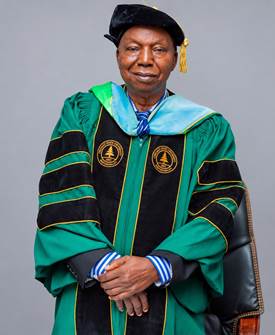
…As M.A. Jalloh Faces Scrutiny over Recruitment & Contracts
A notice informing staff of Milton Margai Technical University (MMTU) that their employment contracts will end on 30 September 2026 has raised fresh concerns about governance and decision-making at the institution.
The notice, dated 25 September 2026 and titled “End of Employment Contract,” was signed by Doreen V. Macfoy, Acting Human Resource Manager.
It states that staff were retained on contract for one academic year, beginning on 1 October 2025 and ending on 30 September 2026. It further explains that the Tertiary Education Commission (TEC) is conducting a staff audit and that employees will be informed of further decisions when the exercise is completed.
According to information made available to this medium, the notice was released on the directive of Dr. Mohamed Alie Jalloh, who is in an acting position that is not discussed and approved by the University Court as alleged. However, the notice itself does not indicate who authorised its issuance.
Those raising concerns about the notice are questioning whether the university administration has the authority to make decisions affecting the employment of all staff without the approval of the University Court.
They maintain that the administration cannot unilaterally review, terminate or renew staff contracts because such responsibility falls within the authority of the University Court.
However, the legal effect of the notice can only be properly determined after examining the affected employees’ contracts, MMTU’s conditions of service and any relevant resolution passed by the University Court.
Questions about Dr Jalloh’s Eligibility
Some members of the university community have also questioned Dr Jalloh’s eligibility to occupy the position he is acting.
They claim that he is approximately 75 years old and has remained at the university beyond the age at which many of his contemporaries retired.
They further allege that during the last TEC staff recategorisation exercise, Dr Jalloh was retained as a Teaching Fellow and was not recategorised as Lecturer I because he did not provide sufficient academic evidence to support him to be placed in the rank of a lecturer in any University.
On that basis, those questioning his appointment argue that he is neither a Senior Lecturer nor an Associate Professor.
The Universities Act, 2021, states that the Vice-Chancellor and Principal of a technical university should be a person of high academic and administrative distinction holding at least the rank of Associate Professor.
The Chancellor and the Ministry of Technical and Higher Education should therefore clarify Dr Jalloh’s substantive academic rank, retirement status and the legal basis of his acting appointment.
No official personnel file, TEC recategorisation document or proof of Dr Jalloh’s age was provided with the allegations. These matters should be independently verified through the appropriate records.
Who Chaired the Interview Panels?
Another major question being raised concerns the recruitment interviews that later became the subject of controversy at MMTU.
Sources familiar with the exercise alleged that Dr Jalloh chaired all the interview panels and was responsible for ensuring that the assessment papers contained the necessary marks, grades and written comments.
According to the sources, the Minister later questioned how candidates could have been properly assessed when some of the papers reportedly contained no written comments.
They further allege that the Deputy Registrar responsible for Human Resources reminded Dr Jalloh about the missing information, but he reportedly dismissed the matter as unimportant.
The same sources claim that during meetings when the issue of the raw scores came up, Dr Jalloh said the Minister had no right to request the raw interview scores. But today the same Dr. Jalloh is spending all him time in the Ministry booth licking to the Minister and Chief Technical Education Officer.
Those seeking answers are now calling for the original assessment papers, panel reports, raw scores and written comments to be secured and examined—provided the documents are still available. As the Court members have requested those documents must be given to a forensic expert to determine who committed the crime.
They also want the professors and other officials who served on the interview panels to be questioned. Their evidence could establish who attended the interviews, who assessed each candidate and who prepared the final recommendations submitted to the administration.
Allegations of Personal Influence
Questions have also been raised about whether personal relationships influenced the treatment of certain candidates.
One account alleges that Professor Philip John Kanu wanted a staff member identified as Mrs Rida to be retained, but Dr Jalloh objected.
Dr Jalloh was alleged to have complained that Mrs. Rida did not greet him and described her as “proud” “disrespectful”, “has no respect for the University Authority”‘ ‘’very challenging, confrontational” and a “nonconformist.” Dr. Jalloh reported all of that to the Administration.
Another candidate who had reportedly distanced himself from Dr Jalloh was allegedly subjected to a particularly difficult interview, after which unfavourable remarks were included in the report.
Similar concerns were raised regarding a former police officer who attended the interviews, as well as alleged attempts to remove Mrs. Jumu and several other employees.
The interview records and testimony of the panel members will be necessary to establish whether the assessments were based on professional considerations or personal differences.
Why is everything Being Blamed on Philip Kanu?
It is unfair that the current discussion has solely focused on Professor Philip John Kanu, despite claims that he did not conduct or chair the interviews.
It is reported that Dr. Jalloh chaired the panels, participated in the assessment process and made representations to Professor Kanu concerning different lecturers.
They are therefore asking why the public discussion has become entirely about “Philip, Philip,” while the roles played by those who conducted the interviews have received limited attention.
According to information provided, the original dispute involved approximately 105 lecturers who were not retained.
It was reportedly established that some had exceeded the required age, some did not participate in the application process, and others failed to apply to the appropriate departments.
These details should be examined against the official recruitment instead of placing responsibility for every decision on one person. As the role Philip Kanu played is to chair the Appointment and Promotion Committee that has all the Deans and some court member were Dr. M. A. Jalloh presented the interview report that also contain the grades awarded to the staff.
Staff who attended the interview were graded and those were the grades presented to the Appointment and Promotions Committee which the committee approves and the report was presented to the court.
They are calling for a comprehensive investigation covering every official who participated in the recruitment process.
Brookfields Land and University Funds
The controversy has also extended to allegations involving university land at Brookfields, the institution’s endowment fund and control over internally generated revenue.
Those speaking on the issue allege that the present campaign against Professor Kanu has little to do with his performance and may instead be connected to disagreements over the Brookfields property.
They further claim that Dr Jalloh’s sole aim is to have access to the university’s accounts without first obtaining approval from the University Court.
Professor Kanu reportedly instructed that the endowment fund should not be touched.
The funds are said to include money generated from the leasing of the university cafeteria, amphitheatre and other commercial activities conducted on university land. The money was reportedly placed in a business account and reserved for development programmes.
Concerned stakeholders have also accused Dr Jalloh of preventing members of the University Court from meeting to discuss the problems affecting the institution.
They question how the university can be properly administered if its highest governing body is unable to meet and deliberate on important matters.
They argue that decisions involving staff contracts, account signatories, suspensions and senior appointments should not be taken without the involvement of the Court.
The dispute has previously attracted the attention of Parliament’s Committee on Technical and Higher Education, where questions were raised about unilateral decision-making and the authority of the University Court.
A call for openness and accountability
The latest notice has left staff and members of the public seeking answers to several important questions:
Who authorised the notice ending the staff contracts? Was the University Court consulted? Does the notice affect every employee or only those holding one-year contracts? Who chaired and participated in the recruitment interviews? Where are the raw scores and panel reports? What is Dr Jalloh’s confirmed academic rank? Was there any attempt to change the university’s account signatories without Court approval?
The controversy surrounding MMTU cannot be resolved through personal attacks, political influence or the selective blaming of individuals.
There must be an independent investigation based on official documents, University Court minutes, personnel records, interview papers, financial records and the Universities Act.
The public deserves to know who made the disputed decisions, who had the authority to make them and whether the law and established university procedures were followed.