
S/Leone’s Presidency: How Each Left Office
Sierra Leone’s presidential history is the most dramatic in this series. Since the country became a Republic in April 1971, it has had more leaders leave office by coup than by election, one president overthrown twice by soldiers, and one of Africa’s most celebrated handovers, when a 29-year-old military ruler voluntarily returned the country to civilian rule. As of November 2026, the current president is Julius Maada Bio, serving his second elected term after winning the disputed June 2023 election.
Between 1961 and 1971 Sierra Leone was a monarchy under Queen Elizabeth II, with Prime Ministers as Heads of Government; the presidency was created on 21 April 1971. Christopher Okoro Cole, the outgoing Governor-General, served as Transitional President for two days before Siaka Stevens took office.
Siaka Stevens had won the 1967 general election as Prime Minister but was blocked from taking office by a Governor-General’s intervention and a rapid succession of coups; he finally assumed power in 1968. In 1971 he abolished the monarchy and made himself Executive President, converting Sierra Leone into a one-party state under his All People’s Congress. He ruled for fourteen years, surviving further coup attempts and economic decline.
His exit, in November 1985, was a model of its kind. Stevens retired voluntarily, at 80 years of age, and arranged the succession of his army commander, Joseph Saidu Momoh, who was elected in a single-candidate vote. Stevens lived quietly until his death in 1988. He remains the first and, for now, only Sierra Leonean president to have retired from office by choice.
Momoh, a retired Major General with no prior political experience, inherited a collapsing economy and, from 1991, a civil war launched by Foday Sankoh’s Revolutionary United Front (RUF). He introduced a multiparty constitution in 1991, but discontent in the unpaid, poorly supplied army boiled over. On 29 April 1992, a group of young officers led by 25-year-old Captain Valentine Strasser seized power while Momoh was abroad, citing exactly those failures: unpaid salaries and poor logistics for frontline troops fighting the rebels. Momoh fled to Guinea and died there in 2003, a year after the war ended.
Strasser became one of the youngest Heads of State in the
World ruling through the National Provisional Ruling Council as the civil war ground on. His rule was marked by economic chaos and growing international pressure to restore civilian government. In January 1996, his own deputy, Brigadier Julius Maada Bio, removed him in a bloodless palace coup, partly amid splits over whether and how to hold elections. Strasser fled to Guinea and later lived for years in Britain in reduced circumstances before returning home in 2019.
Bio’s three months in power were transformative for the country’s politics. Facing international isolation and a war the junta could not win, he organized multiparty elections in February 1996, and when Ahmad Tejan Kabbah of the SLPP won, Bio handed over power on 29 March 1996, becoming one of the few African military rulers ever to surrender office voluntarily to an elected civilian. The gesture defined his reputation and underpinned his return to power at the ballot box twenty-two years later [3, 5].
Kabbah’s decade in power contained three distinct chapters. First, his elected government was overthrown on 25 May 1997 by a junta of junior soldiers, the Armed Forces Revolutionary Council under Major Johnny Paul Koroma, which invited the RUF rebels into government. Kabbah fled to Guinea. In February 1998, a West African intervention force led by Nigeria drove the junta from Freetown and restored him to office. Third, re-elected in 2002 with 70.3% of the vote as the war ended, he served his second term fully and stood down in September 2007, constitutionally barred from a third. He died in 2014.
Johnny Paul Koroma, a Major freed from prison during the 1997 coup and installed as the junta’s chairman, presided over nine months of joint AFRC-RUF rule marked by some of the war’s worst atrocities. His government was never internationally recognized, and sanctions squeezed it quickly. In February 1998, the ECOWAS intervention force retook Freetown; Koroma’s junta collapsed and he fled, eventually into exile, where he died in 2003. He never held elected office and is the only Sierra Leonean head of state whose entire tenure came through a coup.
Ernest Bai Koroma, an insurance executive who had lost the 2002 election and conceded gracefully, won a tense 2007 runoff with 54.6% of the vote and was re-elected in 2012 with 58.7%, in polls observers deemed free and fair. His decade in office saw post-war reconstruction, infrastructure investment, and the country’s management of the Ebola epidemic, alongside persistent corruption allegations. At the end of his second term, he stood down under the constitutional limit, and in April 2018 handed power to the opposition candidate, Julius Maada Bio, who had defeated his party’s nominee in a runoff, completing Sierra Leone’s first transfer of power between elected presidents of different parties since the 1960s.
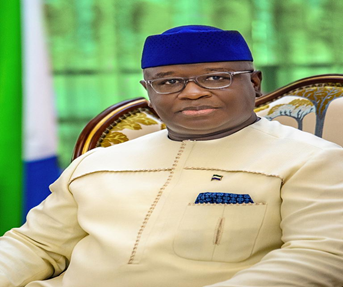
Bio’s return to the presidency through the 2018 ballot was itself historic: the man who had handed over power in 1996 won it back democratically. His first term focused on education reform and anti-corruption drives, but the economy stagnated and food inflation bit hard. In the 24 June 2023 election, the Sierra Leone’s Electoral Commission declared him re-elected with 56.17%, narrowly above the 55% threshold needed to avoid a runoff. The opposition APC categorically rejected the result, and domestic observers’ parallel vote tabulation suggested his true share was between 47.7% and 53.1%, below the threshold, alongside reports of polling stations recording turnout above 100% of registered voters. Bio was sworn in for his second term while the dispute continued; it remains a live controversy in Sierra Leonean politics.
From Siaka Stevens’s voluntary retirement in 1985, through three coups that toppled Momoh, Strasser, and Kabbah, through Julius Maada Bio’s celebrated 1996 handover to an elected government, through Kabbah’s restoration by foreign soldiers and his completion of two terms, through Ernest Bai Koroma’s orderly stand-down in 2018, to Maada Bio’s disputed re-election of 2023, Sierra Leone’s eight presidencies in fifty-five years contain every mechanism of political change on the African continent except assassination and court annulment: retirement, coup, palace coup, voluntary handover, military restoration, and term limits. No other country in this series has used so many, and no other country’s story so closely tracks the difficult construction and recent consolidation of democratic order.