




Why politicians court Soweis, why communities comply—and why those marked for leadership feel there is no way out.
July 2023
FREETOWN — Few forces in Sierra Leonean public life mobilize people as effectively as the Bondo society. Led by senior ritual leaders known as Soweis, Bondo’s reach is sustained by secrecy, social pressure and a dense web of obligations that bind families to custom and politicians to turnout. In election seasons, that machinery becomes a ground game—quiet, local, and decisive.
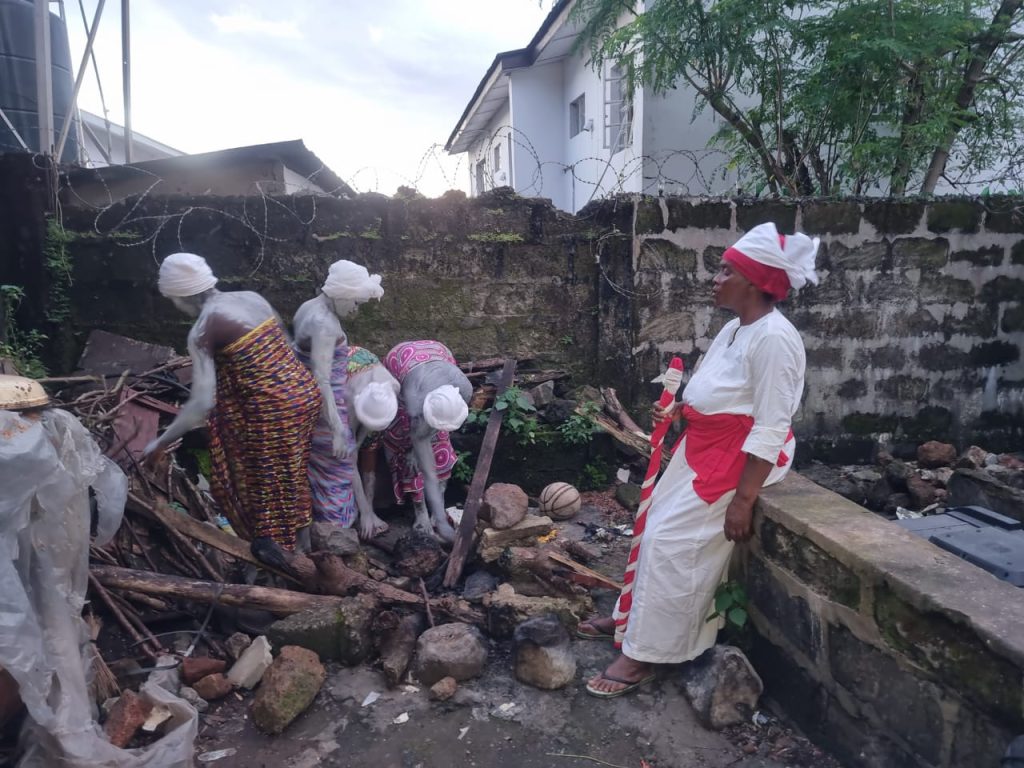
Sowei Zainab Mansaray knows that machinery from the inside. Supporters describe her as a prominent Bondo leader who mobilizes women and engages politicians, particularly within the SLPP; as a Sowei, she holds social and cultural authority in her community and commands networks that can turn out voters. In an interview, she offered an unusually candid account of the bargain—part defense of a tradition, part admission of how tightly it is bound to power. “Women are organized, numerous, and decisive,” she said.
At the heart of Bondo’s influence is simple arithmetic: membership is the norm, not the exception. Roughly 83% of women aged 15–49 have undergone cutting as part of initiation, with support for continuation still high in many communities. Rural prevalence outstrips urban, and large shares of adults believe the practice is required by religion or necessary for social acceptance and marriageability. Under those conditions, “opting out” is not just a personal choice—it is a public rupture.
Mansaray begins with what Bondo means to those inside it. “Bondo is our sisterhood,” she said. “It teaches respect, marriage readiness, and cultural identity. It’s one of the few moments girls are celebrated and gain recognition in the community.” Asked why cutting remains so common, she pointed to the weight of expectation: “Our communities expect it. We believe it’s cleaner, more beautiful, preserves virginity, and is required by faith or tradition. Families fear stigma if a girl remains uninitiated.”
Legally, the landscape helps explain why the status quo holds. Sierra Leone has no national law that specifically bans FGM/C. A nationwide halt announced in November 2014 during the Ebola crisis was lifted after the epidemic, and, while the Child Rights Act (2007) and some district MoUs have been used to curb under-18 initiations, there is no comprehensive prohibition of the practice itself.
Mansaray acknowledges the gap. “We respect the laws on children. Communities are talking about age and consent. Some areas signed MoUs to protect minors, but a national ban does not exist.”
Politics doesn’t just accommodate Bondo; it often relies on it. Researchers and advocates have documented instances of candidates paying initiation fees to curry favor with Soweis and their networks. Chiefs, who authorize Bondo “bushes,” derive revenue from licenses and fines, creating a formalized link between customary authority and the society. In communities where Bondo can levy penalties—and where refusal risks a ritual curse—the incentives to conform are powerful and immediate.
Mansaray says the arrangement runs in both directions. “Politicians support our ceremonies and sometimes even visit our bushes because they know we can mobilize our members,” she said. Pressed on whether that is transactional, she rejected the framing: “Supporting Bondo is acknowledging our role. If they help with costs, families are grateful. That’s community, not just transactions.” She also dismisses the idea that Soweis are political puppets: “we negotiate for our communities.” She traces that influence to the past. “From Madam Yoko’s time, Bondo networks have been sources of influence for women. Today we Soweis still mediate with chiefs and politicians and organize women at scale.”
Bondo also sustains an economy. For many women—especially those displaced by war or lacking formal employment—Sowei training and initiation work offer a livelihood. Fees, foodstuffs and gifts flow to practitioners; in IDP camps after the conflict, “training bushes” proliferated, drawing younger women into the trade. That rush, senior Soweis warn, can produce “over-cutting” by poorly trained initiators—one symptom of commercialization colliding with sacred craft.
Mansaray describes the work as a livelihood. “For women without formal jobs, Sowei work is a livelihood,” she said, adding that senior Soweis mentor juniors for years. “When untrained people rush, mistakes happen. That’s why we insist on proper apprenticeship.”
The society’s power is social before it is electoral. Development groups note forced initiations when girls voice anti-FGM views, and they caution that asking a single family to abandon the practice is unrealistic given the community pressure and stigma non-initiates face. In effect, social sanction functions like a local whip: keeping the line, punishing deviation, and signaling that leadership—especially a coveted path like becoming a Sowei—is destiny, not preference. For those selected, the combined weight of duty, livelihood and status can make “no” feel impossible.
Mansaray does not deny the pressure. “Social acceptance is real. In some areas, uninitiated women can’t join certain gatherings. That’s why many families choose initiation,” she said. Her own household is no exception. “For me, all my children must belong. They dare not disobey me,” she said, adding that she would be happy when one of her children continues her legacy. Asked how choice can be genuine under such pressure, she answered: “Every society has norms. Our work is to ensure respectful dialogue so women are not shamed.”
Public health and rights debates collide here.
Traditional practitioners (not medical staff) perform the vast majority of procedures; medical bodies and human-rights instruments list severe short- and long-term risks, from hemorrhage and infection to complications in childbirth and psychological trauma. At the same time, pro-FGM actors assert cultural autonomy and adult choice, arguing that cutting is inseparable from Bondo’s identity. The result is a rhetorical stalemate in which both sides deploy the language of rights while communities continue to navigate daily realities.
Mansaray frames the health debate as one of respect. “Many feel outsiders don’t respect our culture. Some of us are open to discussions on safety and health education, but we also believe adult women have a right to choose our traditions,” she said. Confronted with data showing that traditional practitioners perform the vast majority of procedures and that medical risks are real, she replied: “We hear those concerns. That’s why many Soweis want better training, hygiene, and clear rules on age and consent—without outsiders like the West insulting our identity.” On whether Bondo could continue without cutting, she was noncommittal: “Some say yes; others say cutting is inseparable from initiation. These are ongoing internal debates.”
For politicians, the calculus is blunt. Opposing Bondo risks alienating an organized women’s constituency; aligning with it secures access to mobilizers who can deliver attendance at rallies and votes at polling stations. Even ministers have publicly framed anti-FGM campaigns as foreign impositions—a signal of how sensitive the issue is for officeholders whose fortunes are decided in local chiefdoms long interlaced with Bondo structures.
Mansaray confirms the calculation. “Some do,” she said when asked whether politicians fear taking a strong stance. “Opposing Bondo publicly can cost votes, so many say ‘respect culture.’ We engage them to keep dialogue respectful.”
What would it take to change this equilibrium? Advocates argue for comprehensive national legislation alongside patient community engagement: invest in trust, involve men and women, protect survivors, and create alternative rites of passage that preserve celebration without cutting. Crucially, they emphasize economic and educational empowerment, so the Sowei role is not the only viable livelihood for women who command respect in their communities. None of this works without political will—from Parliament to police posts—to enforce child-protection clauses and to protect those who step off the customary path.
Mansaray, for her part, says she favors dialogue over prohibition. “Outright bans create conflict; dialogue protects girls and our culture,” she said. On a firm community rule against under-18 initiations, she signaled openness: “Many communities are already moving that way with MoUs. If it protects children and preserves our society, I will support it.”
Until then, Bondo remains both institution and instrument: a keeper of identity, a vote-getting machine, an economic ladder, and a gatekeeper to womanhood. In that world, the girl marked out for Sowei training inherits more than a title—she inherits a mandate. Between family honor, community sanction and political utility, many conclude there is no real escape from what elders call her “calling.” That is the Bondo bargain: powerful enough to make and unmake public lives, and intimate enough to feel, for those destined to lead it, like fate.
Editor’s note: Data and quotations referenced above draw on research by FORWARD (2017), 28 Too Many (2021) and peer-reviewed analysis of Bondo’s political economy and post-Ebola legal context. Quotations attributed to Sowei Zainab Mansaray are drawn from the author’s interview with her