

The Sierra Leone Ports and Harbours Authority (SLPHA) has emerged as key facilitator in the fight against illicit maritime trafficking and organized crime across Latin America, the Caribbean and West Africa.
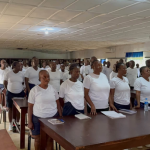
The Authority, in collaboration with Seaport Cooperation Project (SEACOP) which is funded by the European Union, supported the project in the conduction of a two-day -31st March to 1st April, 2026 practical training for stakeholders in the Sierra Leone maritime sector at the Queen Elizabeth II Quay by providing practical space (vessel, environment, and human resource) for the exercise.
The practical sessions were a continuation of what the trainers and trainees commenced theoretically in March, 2025.
Lead Trainer of SEACOP and Head of the Joint Port Control Unit of Ghana, working with the Narcotic Control Commission of Ghana, Francisca Ziniel explained that the training is to equip officers of the maritime sector to fight transnational maritime crime such as illegal drugs among others. Madam Ziniel disclosed that it is their third time in Sierra Leone, and their current mission focuses on mentorship to assess how far the trainees have been able to practicalize what they have been taught, and to equally mentor them to do it better. “This practical training involved unaccounted persons and drugs which were the scenarios and they (trainees) were excellent in terms of performance.” She maintained that as they had no access to a vessel, the performance of the trainees was unsatisfactory in 2025. However, with the support of the Sierra Leone Ports and Harbours Authority (SLPHA) and the Office of National Security (ONS) a vessel was made available which resulted to improvement on performance.
“With the way they were able to uncover all the three bags which we hid in different places, and the way they asked questions and engaged with crew members, it shows that they have been listening, learning and practicing well,” she admitted during the practical session. Ziniel admonished trainees to utilize the theories and skills given them as that is what matters. Having officers onboard a ramage vessel according to her, puts the country in a positive limelight as it sends a message to the world that when it comes to transnational crime, the Government of Sierra Leone and the SLPHA are up to the task, cooperating with the ISPIS Code. “Such structure attracts a lot of investment,” she posited.
A member of the Combined Maritime Control Unit (CMCU), Tamba Mbayo said the project is a ramage training exercise which was mainly meant to refresh trainees and people who have been part of the team on how to use the knowledge they have acquired. He stated that it is a combine exercise comprising participants from the Office of the National Security (ONS), the Sierra Leone Ports and Harbours Authority (SLPHA), Interpol, the Transnational Organized Crime Unit (TOCU), the Sierra Leone Police (SLP) and Sierra Leone Navy. He described the training exercise as one which is very good for Sierra Leone as it will improve on the security status of the country within the region and globally. “This a significant training for key players within the maritime sector and it is timely and appropriate for beneficiaries,” he stated.
Ing. Abdulai Dumbuya, Maritime Officer explained that the exercise better prepares them on how to counter illicit drug inflow.
Credit: SLPHA COMMUNICATIONS