By Feima Sesay
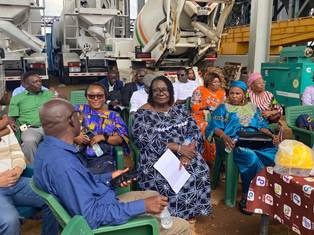
The Parliamentary Committee on Trade and Industry has conducted an oversight visit to SR Construction Company, a cement manufacturing facility, on Tuesday, 17th November 2026, to assess the company’s operational activities, level of preparedness for production and compliance with relevant agreements.
The delegation was led by the Chairperson of the Committee, Honourable Veronica Kadie Sesay, who explained that the visit was intended to obtain first-hand information about the company’s operations, its relationship with surrounding communities, employment opportunities for Sierra Leoneans and measures put in place to address potential environmental and occupational hazards.

Honourable Veronica emphasised that the Committee’s responsibility extends beyond lawmaking and representation to ensuring that businesses operating in the country fulfill their obligations to the state and the communities in which they operate.
She said the Committee was particularly interested in understanding the company’s progress towards establishing a cement factory, its corporate social responsibility initiatives, staffing arrangements, workers’ welfare and environmental protection measures.
The Chairperson also highlighted concerns about potential noise pollution, smoke emissions and other health risks associated with cement production, stressing the importance of appropriate preventive measures to protect surrounding communities.
She further explained that other parliamentary committees, including those responsible for finance, environment and labour, would undertake their respective oversight responsibilities to examine the company’s tax obligations, environmental compliance and employment conditions.
Responding to the Committee’s concerns, the Project Manager disclosed that SR Construction Company was currently testing its machines individually as part of preparations to commence full-scale cement production.
He explained that the company had already placed orders for essential raw materials, including clinker and gypsum, which were expected to arrive in Sierra Leone in March 2027.
According to him, production is expected to commence between 15th and 30th March 2027, subject to the arrival of the raw materials and the successful completion of machinery testing.
On employment and skills development, the Project Manager said the company intended to recruit between 120 and 150 local technical workers for different operational departments, including electrical, mechanical, fabrication, crane operations, grinding, packaging, loading and unloading.
He explained that the company planned to engage experienced foreign specialists to train local workers, enabling them to acquire the technical knowledge required to operate the factory independently.
He identified the shortage of skilled local technicians, particularly in electrical engineering and fabrication, as one of the major challenges confronting the company.
He further disclosed that the company had engaged with students from a local university and promised to recruit at least five individuals from a group of 30 students for practical training under experienced engineers.
Meanwhile, Engineer Mohamed, the company’s Manager, informed the Committee that SR Construction currently employs approximately 120 workers and is making contributions to the National Social Security and Insurance Trust (NASSIT).
He explained that the contributions amount to 15 per cent of workers’ basic salaries, comprising 5 per cent deducted from employees’ salaries and 10 per cent contributed by the employer.
He also maintained that workers receive salaries above the national minimum wage.
However, Engineer Mohamed acknowledged that the company continued to face challenges regarding compliance with occupational safety requirements, particularly workers’ consistent use of personal protective equipment (PPE).
He explained that although safety materials were provided, some workers occasionally failed to use them, creating difficulties for management in enforcing safety standards while maintaining daily operations.
On community relations, the Manager described the company’s relationship with surrounding communities as cordial, noting that more than 70 per cent of its workforce comes from the local community.
He said the company works with community representatives when recruiting workers to ensure that residents benefit from employment opportunities in line with the Local Content Act.
Regarding workers’ welfare, he disclosed that the company provides medical assistance on-site and accepts responsibility for workers who sustain injuries while performing their duties.
He further assured the Committee that the company was meeting its tax obligations and other statutory responsibilities.
The oversight assessment provided an opportunity for members of the Committee to raise critical questions and seek further clarification on the company’s operational readiness, employment policies, workers’ safety, community engagement and compliance with its obligations.
The Committee reiterated the importance of ensuring that the establishment of the cement factory translates into meaningful economic benefits for Sierra Leoneans while safeguarding workers, surrounding communities and the environment.