
…As Sierra Leonean Women Take The Fight Against FGM
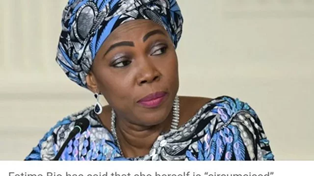
There are few things more disheartening than watching powerful women defend systems that harm other women and girls. Yet that is exactly the message that Sierra Leone’s First Lady, Fatima Maada Bio, has sent recently when she publicly stated her support for continuing Female Genital Msutilation (FGM), in a country where nearly 9 in early 10 girls have been affected.
A video was filmed of an event in Kenema and shared by fellow campaigner, Alimatu Dimonekene, founder of A Girl At A Time, where the First Lady assured the circumcisers present that they had nothing to fear — and that she wanted to make sure that FGM continues.
Before the cancellation of her invitation last night, Bio was also due back in the UK to take part in the ‘Global Power Women Forum’ at the University of Cambridge, an event that aims to illustrate how “First Ladies mobilise influence to accelerate systemic reform”. What makes this particularly devastating is that Sierra Leone desperately needs influential voices willing to challenge FGM. Instead, campaigners found themselves once again battling a political establishment that appears reluctant to confront this extreme form of violence against women and girls. When leaders refuse to take a clear stand, silence becomes a form of endorsement.
Let us be clear about what is at stake. FGM, which happens in this country as part of Bondo — a secret society initiation for girls — is not a harmless rite of passage. It is the cutting of healthy human tissue and a recognised violation of human rights, which leads to lifelong physical complications, severe pain and psychological trauma — and in some cases, death.
At least 230 million women and girls are living with the consequences of FGM. We do not know how many girls have died but research from the University of Birmingham has estimated that there are at least 44,000 deaths per year in the 15 countries they examined. There are of course tens of thousands more girls that we never hear about.
Despite those staggering numbers, FGM remains one of the world’s most neglected human rights abuses. I have been to many international conferences, where gender equality is discussed endlessly, but funding for anti-FGM work remains woefully inadequate — particularly to the frontlines.
For many survivors, the message is clear: your suffering matters as part of a story that we can tell on your behalf, but not enough to attract serious political attention or resources. Our images, stories and our lived experiences are used in annual reports but we rarely find ourselves as recipients of funding. Donors have spent a lot of time talking about women and girls, but not enough investing in the people who are actually working every day to end this abuse.
In 2019, I co-founded The Five Foundation because I was tired of hearing that ending FGM was impossible while seeing grassroots activists across Africa achieving extraordinary things with almost no support. Our mission is simple: get more funding and power to the people closest to the problem.
We have already been successful in doing this and have raised nearly $2 million from seven donors as part of the HER Africa Funder Alliance. This has reached frontline activists working primarily in East Africa. Although this issue is severely underfunded in general — with around $1 available for every woman affected — for the most part, it has been even more challenging to raise funding for West Africa.
Nowhere is that challenge more evident than in Sierra Leone. If a disease affected nearly 90% of women in a country, it would be treated as a national emergency. If a policy resulted in such widespread physical and psychological harm, governments would be under enormous pressure to act. Yet, because FGM is often wrapped in the language of “tradition” — and because supporting it can ensure more votes for politicians, figures like Bio use it as a means for their own advancement. Without political enablement, many donors are sadly reluctant to get involved. This creates a lose — lose situation, where progress is even harder to achieve by those brave women doing so much against the odds.
Donors have also called for more evidence of what works to end FGM. The Five Foundation has addressed that directly by co-creating resourcesforactivists.com with 62 grassroots African groups. We have also worked to ensure best practice principles in early childhood development are embedded into our own work and those of our partners. Ending FGM isn’t just about preventing a cut — it’s about changing a girl’s future, and giving her the chance to live free from violence, with more choices she can make about her own life.
These women were not rejecting their culture; they rejected an abuse that had become semi-legitimised because of political reluctance to ban it, but which was never acceptable in any way.
As an African woman myself — and a survivor of FGM — I expect much more from our continent’s political leaders.
With privilege comes great responsibility. We do not get to champion the great work we do on women’s empowerment one day and then appear to be in favour of the suffering of girls the next.
A somewhat bizarre side note to this outrageous controversy is we have had reports that the First Lady continues to benefit from a council house tenancy in London while living as the very wealthy wife of Sierra Leone’s president — who clearly does not live in the UK. Millions of ordinary British people are struggling to access affordable housing, while social housing waiting lists can stretch for years.
The optics are terrible, but the issue goes far beyond optics. It raises fundamental questions about privilege, accountability and whether public resources are being used as intended.
I believe we will end FGM because I’ve seen too many brave African women fight for too long for it not to happen. But activists and survivors shouldn’t have to carry this burden alone.
Political leaders have a responsibility to stand with women and girls too. Anything less is failing half of our continent.