


BY: Eliasu Jalloh
In Sierra Leone, thousands of girls continue to face two interconnected threats that rob them of their childhood, bodily autonomy, and future opportunities: Female Genital Mutilation (FGM) and child marriage.
For decades, activists, survivors, healthcare professionals, and human rights organizations have worked tirelessly to end these harmful practices. Yet one of the greatest obstacles to progress remains the normalization and public celebration of FGM by influential figures who simultaneously present themselves as champions of women’s and girls’ rights.
FGM is often defended as culture, tradition, or a rite of passage. Behind these justifications, however, are the experiences of girls who are held down, cut, traumatized, and expected to carry the consequences for the rest of their lives. The physical pain is only part of the harm. Many survivors endure long-term psychological effects, including anxiety, depression, post-traumatic stress, and deep emotional trauma.
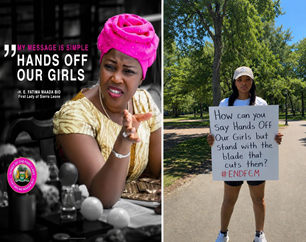
The situation becomes even more troubling when public officials who advocate for women’s empowerment fail to take a clear stand against FGM. Sierra Leone’s First Lady has gained international recognition through the “Hands Off Our Girls” campaign, which seeks to protect women and children, promote girls’ education, and combat child marriage. These are important and necessary goals.
However, many survivors and human rights advocates struggle to reconcile this message with her public association with groups that promote and practice FGM. For them, the contradiction is impossible to ignore. How can a leader campaign against child marriage while remaining supportive of a practice that often serves as a gateway to it?
In many communities across Sierra Leone, FGM and child marriage are deeply intertwined. Initiation through FGM is frequently viewed as a transition from childhood into womanhood. Once a girl has undergone the procedure, societal expectations often change dramatically. She may be considered ready for marriage, pressured to leave school, or expected to take on adult responsibilities long before she is physically, emotionally, or mentally prepared.
This is why many activists argue that efforts to end child marriage cannot succeed without also confronting FGM. Both practices are rooted in the same harmful belief: that a girl’s value lies in her conformity to traditional expectations rather than in her education, aspirations, choices, and individual freedom.
A genuine commitment to girls’ rights requires consistency. Protecting girls means defending their bodily autonomy in all circumstances, not only when it is politically convenient.
For many survivors, this debate is not political, it is personal. They remember the fear, the lack of choice, the pain, and the lasting consequences. Some continue to live with physical complications years later. Others carry emotional scars that have never fully healed. Their voices deserve to be heard. Their experiences deserve to be acknowledged. Meanwhile, if politicians are serious about protecting women and girls, then the conversation must address both child marriage and FGM with equal honesty, courage, and commitment.